.png?width=749&height=158&name=Samatrix+Logo%20(1).png "Samatrix Logo")

.png?width=400&height=84&name=Samatrix+Logo%20(1).png)
In the media, sewage and wastewater pollution is often framed as a failure of individual operators or isolated incidents. In reality, it is more accurately viewed as a system's outcome. Modern sewage treatment systems are designed to balance capacity, cost, and environmental protection. Pollution occurs when that balance is structurally exceeded rather than operationally abandoned.

Two distinct mechanisms underpin this: treatment limitations, where systems cannot fully remove contaminants even when functioning correctly, and design constraints, where infrastructure is intentionally built to discharge under certain conditions. In this article we look at what causes sewage pollution and how both industrial and structural factors contribute to the problem.
Legacy Infrastructure Constraints
Much of the UK’s wastewater network reflects engineering decisions made decades ago, and sometimes a century or more. Large parts of the system are based on a combined sewer design, where rainwater and sewage share the same pipes.
This configuration was practical at the time, reducing the need for separate networks, but it embeds a permanent capacity constraint. Following rainfall, surface runoff from roads and buildings enters the same system as domestic and industrial waste, rapidly increasing flow volumes. The result is a predictable mismatch between system capacity and inflow during peak conditions.
The scale of this constraint is visible in operational data. In 2024 alone, a House of Commons Report recorded approximately 450,000 sewage discharges from storm overflows, lasting around 3.6 million hours. These are not anomalies but recurring outputs of a network operating beyond its designed throughput under modern conditions. Urban expansion and residential development has intensified the issue, because population growth and increased impermeable surfaces (roads, paving, roofing, etc) accelerate runoff into systems that were never resized accordingly. While separate sewer systems are sometimes used in newer developments, the cost of retrofitting legacy networks has historically limited large-scale change.
Industrial And Commercial Load Pressures
Beyond volume, the composition of wastewater creates additional strain on the network. Industrial and commercial discharges contribute a range of substances, including chemical effluents, heavy metals, and synthetic compounds, to the public sewer that differ significantly from domestic sewage.
These inputs affect both treatment efficiency and system stability. Many treatment processes are calibrated for organic waste breakdown; the presence of non-biodegradable or toxic substances can inhibit biological treatment stages or require more advanced processing than existing facilities provide.
Regulatory frameworks set limits on industrial discharge, but these thresholds are negotiated within economic constraints. As a result, treatment systems often receive influent that is legally compliant yet operationally challenging. This creates a structural tension: systems must process increasingly complex wastewater without equivalent upgrades in treatment capability. The issue is not simply excess volume but increased treatment complexity, which reduces overall system resilience and raises the likelihood of partial or untreated discharge under stress conditions.
Storm Overflows As Designed Failure Points
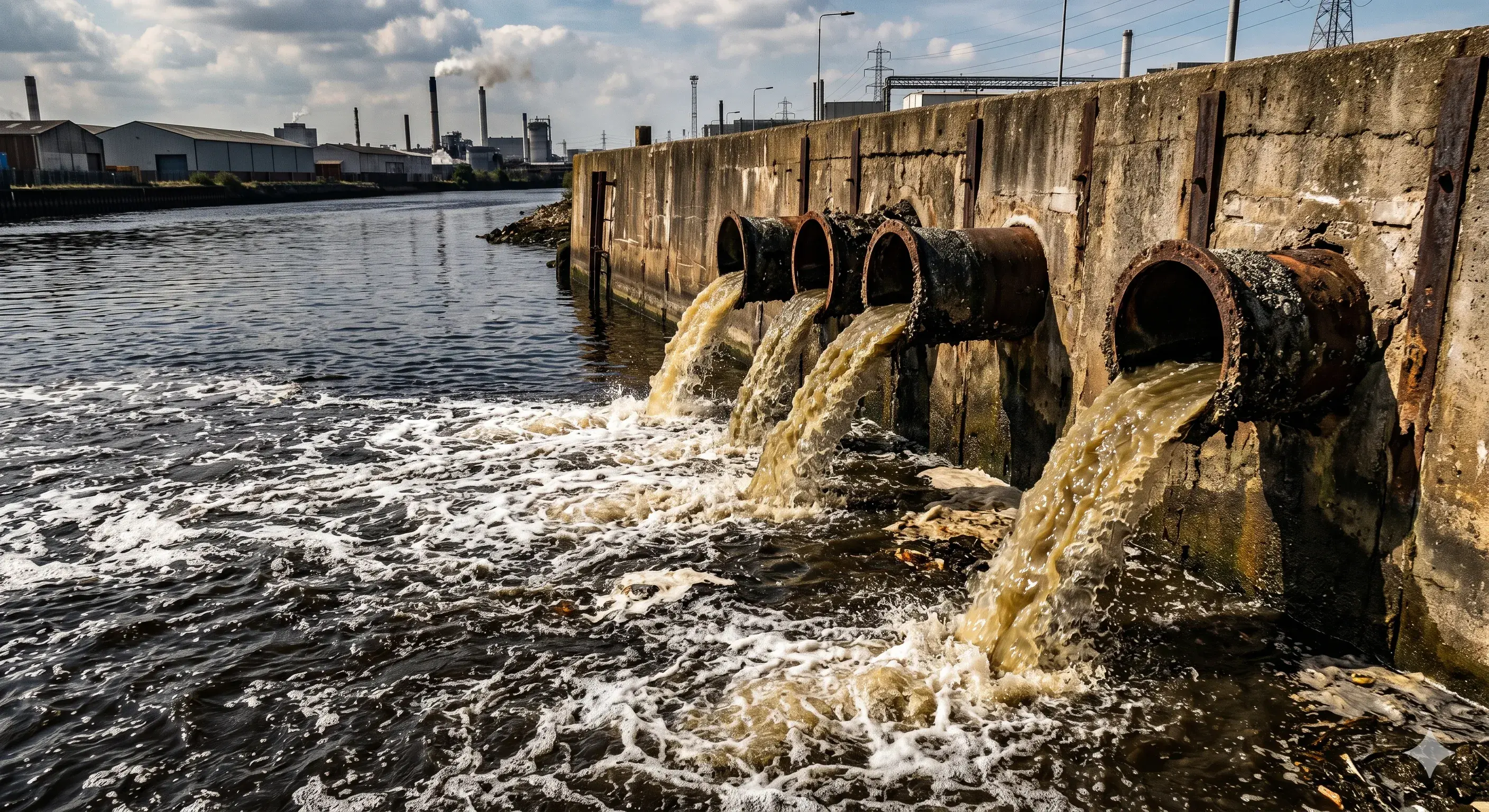
In the press, storm overflows are frequently interpreted as evidence of system breakdown. In fact, they are an explicit design feature: a safety valve to prevent sewage backing up into homes and urban areas when network capacity is exceeded.
Under heavy rainfall, combined sewer systems can carry flows far beyond their treatment plant capacity. Storm overflows divert excess wastewater (containing untreated sewage and wastewater pollution) directly into rivers or coastal waters.
This is not an accidental release but a controlled discharge mechanism embedded in system design. However, the scale and frequency of these events illustrate how routine this mechanism has become. Rainfall variability further exposes the structural nature of the issue. Wet years and unpredictable seasonal precipitation patterns produce sharp increases in spill frequency, while drier conditions temporarily reduce discharges without altering the underlying capacity limits.
The result is that system capacity is now routinely exceeded under normal climatic conditions.
Treatment System Limitations
Even when wastewater reaches treatment facilities, removal of contaminants is often incomplete. Standard treatment processes operate in stages: primary (solids removal), secondary (biological treatment), and, in some cases, tertiary (advanced filtration and disinfection).
Each stage has defined capabilities and limits. Nutrients such as nitrogen and phosphorus, microplastics, pharmaceutical residues, and certain pathogens are not fully removed by conventional treatment. This means that treated effluent can still contribute to environmental pollution, even in the absence of overflow events. Upgrading treatment systems to address these contaminants will require significant capital investment and energy input. As a result, many facilities operate within the lines of regulatory compliance while still releasing partially treated wastewater that affects ecological conditions over time.
The constraint here is technological as much as infrastructural. Systems are not universally designed to achieve complete contaminant removal, particularly for emerging pollutants.
Regulatory And Operational Trade-Offs
The performance of sewage systems is shaped by regulatory frameworks that balance environmental outcomes with economic feasibility. Permits governing discharges, including storm overflows, reflect this balance, allowing releases under defined conditions rather than prohibiting them outright.
Investment cycles further influence system performance. Large-scale infrastructure upgrades are capital-intensive and implemented over decades. For example, major projects such as the Thames Tideway Tunnel are expected to significantly reduce overflow events in specific regions, but such interventions are not yet system-wide. At the same time, monitoring has expanded significantly, with over 14,000 storm overflows now closely tracked across England. This has improved transparency but also revealed the extent to which discharges are embedded in normal system operation.
Next Steps
At Samatrix, we focus on the operational detail behind sewage and wastewater systems, how they actually perform under pressure, where the constraints sit, and what that means in practice for your operation. If you’re dealing with infrastructure limitations, discharge risk, or regulatory exposure, the starting point is a clearer view of how the system behaves, not how it’s supposed to. For more information, please call one of our specialists today on 01792 949484, or click here to send us a message.
Image Source: Freepilk

The Effect of Storms on CSOs and the Risk of Urban Flooding
5 Main Causes Of Sewage Spills and How To Avoid Them